
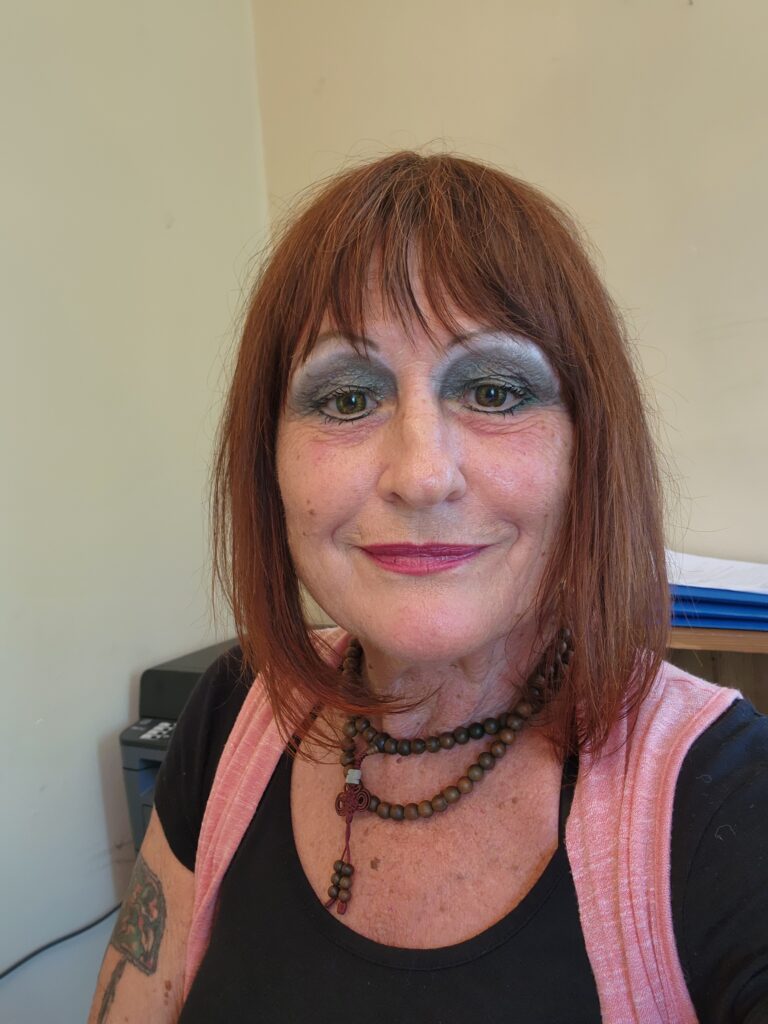
Annette Ritter used to write horror stories and see them published in small press “zines.”
But her fiction had nothing on the facts of her own past life of drug addiction and family tragedies. And as works of fiction, those stories pale in comparison to the harsh realities of polarization that Annette, a bright light in the Braver Angels constellation, now fights against.
Annette, a self-declared Other (not Red, not Blue), is one of the leaders of the We the People’s Project (WPP) – the subgroup she can claim some authorship of following a long and thoughtful conversation with Braver Angels co-founder David Lapp a couple of years ago.
With her articulacy, her drugs-to-dreams self-transformation, and her long-ago background working wherever there was a paycheck – nursing homes, cafes, wherever – to her current profession as an addiction counselor, Annette has perspectives and capabilities that make her invaluable to the group whose purpose is to involve the almost two-thirds of Americans who don’t have four-year college degrees.
It’s a mission Annette is passionate about. “I come from working people; my mother was a homemaker and my father was a Teamster,” she says. “But [in public discussions] you never hear from regular people. You always hear from the politicians, the experts, the academics – not the average Joe who works at a fast-food place.”
Annette first came across Braver Angels when her good friend, an instructor in one of the college courses that Annette was taking, invited her to a college debate on healthcare. “My friend evidently saw the advocate and speaker in me,” recalls Annette. That inner advocate spoke out eloquently, taking the position that America doesn’t really have a healthcare system so much as a health insurance system.
The debate format intrigued her. “I was impressed with the way the moderators handled touchy situations. I also loved the [Braver Angels] name,” she says. The purpose of the organization also resonated; Annette was president of the Peace Club group on the Allegany College of Maryland campus.
She joined Braver Angels almost immediately. It wasn’t long before David Lapp came a-calling. The possibilities that came tumbling out of their lengthy conversation led David to reach out to others – Rita Chisum and Wilk Wilkinson among them – who would become the core WPP group.
Together, they began envisioning what they could do to turn their ideas into actions. “It left me excited about what’s next,” says Annette. “It was like standing up on top of a high dive and feeling like you can fly.”
WPP got its start in April 2021. Annette helped work out the wording on the marketing statement: “giving the average person time at the podium.” With input from the WPP group, Annette was out in front of the idea of forums – not debates, not workshops, but conversations. The virtual events were designed as spaces where working people of whatever stripe would be welcome to speak out on issues they experience and care deeply about – yet often feel they have no room and even no right to speak about.
The first forum in May 2021 — on the topic of whether expanded unemployment benefits are fair to American workers – was an instant success, drawing a substantial audience around an energetic discussion. Other events followed in quick succession, spotlighting everything from homelessness to proposals to get money out of politics and pulling in more than 200 participants nationwide. “The momentum is building!” says Annette.
Annette led the design of and hosted April’s forum on the topic of whether higher education is a bridge or a barrier for the working class. Abortion (one of Braver Angels’ most successful debate topics recently) is likely to be the theme of an upcoming forum, as is the notion of a third political party – a theme that Annette, as an independent, is especially keen on.
For all its successes to date, though, the WPP still faces an uphill struggle. A challenge is reaching – really reaching – the demographic that WPP is designed to reach. “We’re trying to find ways to get the attention of people who aren’t so easy to get a hold of – and overcome that stigma of who gets to speak,” observes Annette. “The real problem seems to be diversity – getting that group of hard-core Reds, disgruntled Blues, and the growing number of independent/ unaffiliated voters to speak up because they’ve been shut down so often.”
Implicit in her comment is the fundamental truth that working people are busy, well, working. And when they’re off work, the last thing most of them want to do is sit down to do the hard work – yes, work – of thinking about and talking about big issues that they feel they’re not entitled to voice openly.
“Marketing is tricky; we’re barely a year old, and we’re just a part of a fairly new national organization,” says Annette. So she and the WPP team are “looking outside of ourselves,” as she puts it, contacting other Braver Angels’ groups to see how they can leverage their platforms.
One outcome of that outreach: WPP’s initiative will be the focus of an upcoming Ambassadors meeting. And team members including Annette and Wilk are looking at how WPP’s mission could be implanted in the activities of alliances all over the country.
Meanwhile, the forums will surely proliferate, ideally with more publicity to attract even bigger audiences. “The more forums we have, the more videos we have to show,” Annette says.
Annette would love to see WPP programs catch fire in community colleges nationwide. “We need more young people,” she says. “They’re the ones we need to hear from the most; they’re the ones who’ll be affected the most.”
With her energy, her passion, and her creativity, it’s a good bet that Braver Angels is about to become much more familiar to the “average American” — the people whose opinions and votes count just as much as those of the minority who attended four-year colleges.