

By: Gabriella Kearns, Senior Fellow, Civic Storytelling
Daniel Darling has undeniably Red roots.
As a young man, Daniel’s father emerged from a broken, dysfunctional home looking for direction and found it while attending a Billy Graham crusade in Chicago. There, he “walked forward”—committing himself to Jesus Christ and changing the trajectory of his family. Not long after, he married Daniel’s mom, a Christian convert whose grandparents sought refuge in America after escaping pogroms in Europe.
Together, Daniel’s parents gave him a foundational commitment to his faith and a steady love for his country. “I’m a Christian first, then an American, then a conservative, and then a Republican, in that order,” Daniel said. But he was also raised with an openness to the world and the different people within it. “Even though we grew up in a very conservative household, we had free-flow ideas and debates at the dinner table,” he said.
These values—along with a knack for writing (“I can’t dance, I can’t make furniture, but I can write, so I write,” he said)—informed his career as an author, pastor, and thought leader in the evangelical space, pursuing the question of “how Christians should apply their faith in the public square,” at a time of particularly intense polarization. But in August 2021, a year and a half into the pandemic that ravaged the lives of Americans and further inflamed our politics, Daniel found himself caught in the crosshairs of the culture war he’d spent his career helping people navigate.
“It was a jarring experience, and it was public.”
“We had lost a friend of ours,” he said. “Our kids’ piano teacher had unexpectedly died of COVID and it really devastated our family.” So, he did what he always does: he began writing about the experience and how it, in part, solidified his decision to get vaccinated. “It wasn’t even really a prescriptive thing, saying you need to go get the vaccine,” he said. “I was essentially saying, you know, I understand why there’s skepticism—the public health officials have been inconsistent, they’ve lost trust—but here’s why I got it.”
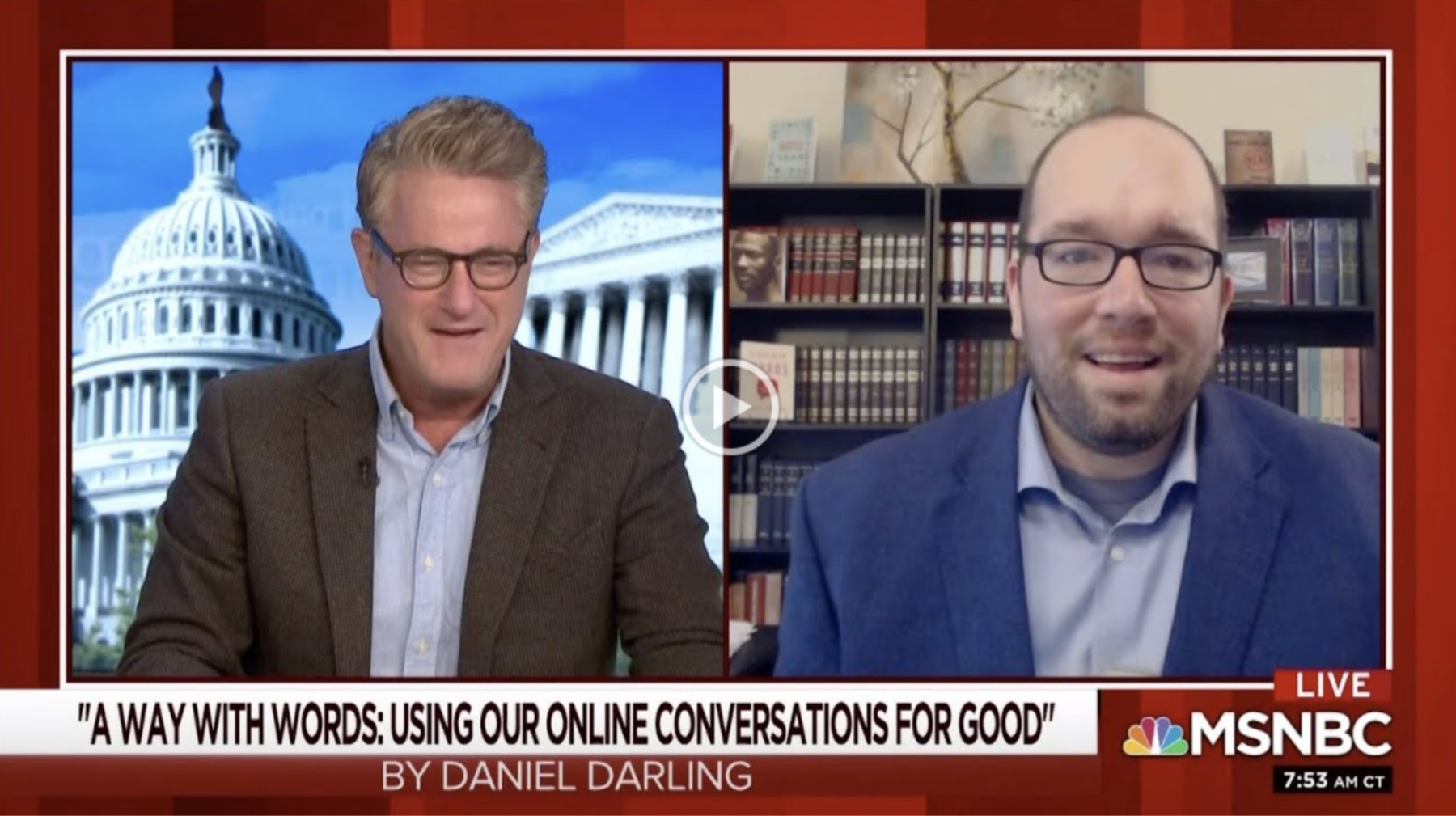
At first, the pushback came from the left. “I got calls from people saying, ‘You should have crushed evangelicals. They’re anti-science,’” he said. “I was like, ‘Actually no they’re not. 75% are getting the vaccine.’ I was defending my own tribe.” But then, an appearance on Morning Joe discussing the piece ultimately led to him getting fired by his employer, The National Religious Broadcasters (NRB), which reportedly claimed his comments “violated the organization’s policy of neutrality on COVID-19 vaccines.”
This set off a firestorm on social media. “It was a jarring experience, and it was public,” he said. So public, in fact, his name was trending alongside the removal of troops in Afghanistan. “It was weird to go online and you’re one of the top three stories,” he said. Still, the experience left Daniel surprisingly hopeful. “I was discouraged, obviously, by being let go,” he said. “But I was encouraged by the overwhelming support I got from fellow evangelical Christians, public figures, and people across the political spectrum—regardless of where they stood on the vaccine—who really supported me.”
“If something like that happens to you, there’s so much incentive to punch back… It’s like, man, I disagree with what happened to me, but I just don’t want to go that route.”

In this way, Daniel’s firing was both exceptional and conventional—a sign of the most unusual times. On one hand, in the midst of the pandemic, he was hardly the only person to be let go because of their political views. But given these cancellations had become so pervasive, a sort of playbook had emerged: First, get shut down by one side. Then, lash out against them. Finally, become the hero of the other side. (Or, to riff on the adage: become one side’s enemy and the other side’s friend.)
But Daniel had no interest in capitalizing on the moment and carving out his place as some anti-anti-vaccine warrior. He wasn’t looking to condemn the people who condemned him. Instead, informed by his faith and love of country, he took a different approach: urging everyone—especially his fellow evangelicals—to come together.
“I really wanted to handle the moment well,” he said. “If something like that happens to you, there’s so much incentive to punch back and use that moment to get your pound of flesh and make a name for yourself. And I had a lot of folks telling me, ‘You really need to go after conservative evangelicals and how backward and stupid they are.’ It’s like, man, I disagree with what happened to me, but I just don’t want to go that route.”
“What Braver Angels is trying to do is help preserve our country and hold us together. I think it’s a deeply conservative thing.”

Daniel’s faith both grounded and guided him through the process. “It gave me an opportunity to model reconciliation and unity,” he said. “The people who disagree with us are human beings, and as a Christian I believe they’re made in the image of God, and they’re worthy of dignity and respect.”
Naturally, he’s found a place within the Braver Angels community. “One thing I like about Braver Angels is it doesn’t ask you to give up who you are to be part of it,” he said. “They’re not saying you have to be less of a conservative Christian, or less of a liberal Democrat. They’re saying: be who you are, but engage with people who disagree with you.”
For Daniel, that includes people like Mark Beckwith, a longtime leader within Braver Angels and a retired Episcopal Bishop. “Mark and I disagree on a number of things. I mean, we probably don’t vote the same way and even theologically we differ,” he said. “And yet, there’s so much we agree on.”
At its core, this work aligns with Daniel’s most deeply-held values. From a Christian perspective, “part of seeing people as human is not seeing them as an avatar to be crushed or as a caricature, but as real human beings,” he said. But also, it speaks to his beliefs as a conservative. “At the heart of conservatism is the idea of conserving and preserving the good things,” he said. “What Braver Angels is trying to do is help preserve our country and hold us together. I think it’s a deeply conservative thing.”