

How Americans Can Find What They Have in Common - Braver Angels

How Americans Can Find What They Have in Common

By Zaid Jilani, Greater Good Magazine

The 2002 film My Big Fat Greek Wedding resonated with millions of people around the world—it retains the title of the highest-grossing romantic comedy in history. Why? Perhaps because its central conflict is one that countless couples have endured.In the film, Greek-American Toula Portokalos falls in love with a non-Greek named Ian Miller. Ultimately, the couple overcomes this barrier and they happily wed. At the wedding, Toula’s father explains how he came to terms with the reality that his daughter would be part of an intercultural family.

This is an example of what social scientists call “superordinate identity”—a shared identity between groups that transcends the more narrow, particular identities that seem to divide them. Portokalos acknowledges that the two sides of the new family come from distinct and proud cultures—an apple and an orange—but that they also share a larger, superordinate identity in common: fruit! Toula and Ian can value the cultures they grew up in but also embrace a larger shared culture they will create with their new family.

Focusing on shared identities is a valuable way for people in diverse societies to bridge their differences without shedding or suppressing what makes them different in the first place. Doing so allows us to come together with people who we previously imagined we had nothing in common with—which research suggests can open the door to greater empathy and cooperation. Today, organizations like Braver Angels and Citizen University are putting these academic insights to work in trying to remind divided Americans what they have in common.

Read the Full Article Here

More to explore

‘Braver Angels really helped me to see the humanity in people from the other side’: One high schooler’s journey to better political conversations

A native of Boulder, Colorado, Mia didn’t know many Trump supporters—and she was nervous to engage with them. “I was like, ‘Don’t they hate women? Don’t they hate black people?’” she said. “That was my initial belief because that’s what I had heard about people who voted for Trump.” But she quickly realized she was wrong. During the first Braver Lens session, Mia was able to connect with conservatives in the group and recognize their points of commonality. “When we met, they showed their pictures, and explained their life stories, and I was able to see where our values overlap,” she said. 

Read More »

How a Christian conservative found his way to Braver Angels

As a young man, Daniel’s father emerged from a broken, dysfunctional home looking for direction and found it while attending a Billy Graham crusade in Chicago. There, he “walked forward”—committing himself to Jesus Christ and changing the trajectory of his family. Not long after, he married Daniel’s mom, a Christian convert whose grandparents sought refuge in America after escaping pogroms in Europe.

Read More »

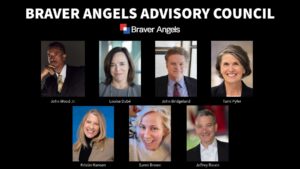
Announcing Braver Angels Advisory Council

Twenty-three leaders who disagree on many things said yes to the same thing this month. They agreed to stand together, publicly, behind the idea that Americans can hold fast to their convictions while staying genuinely curious about the convictions of people on the other side. That’s it. That’s the commitment. For more than nine years, Braver Angels has reached people in every state in the union. The ones who’ve engaged have experienced something that surprises them every time: the relief of disagreeing without contempt, and the discovery that the person across the table is not who the feed said they were.

Read More »

Leave a Comment

Braver Angels Support