

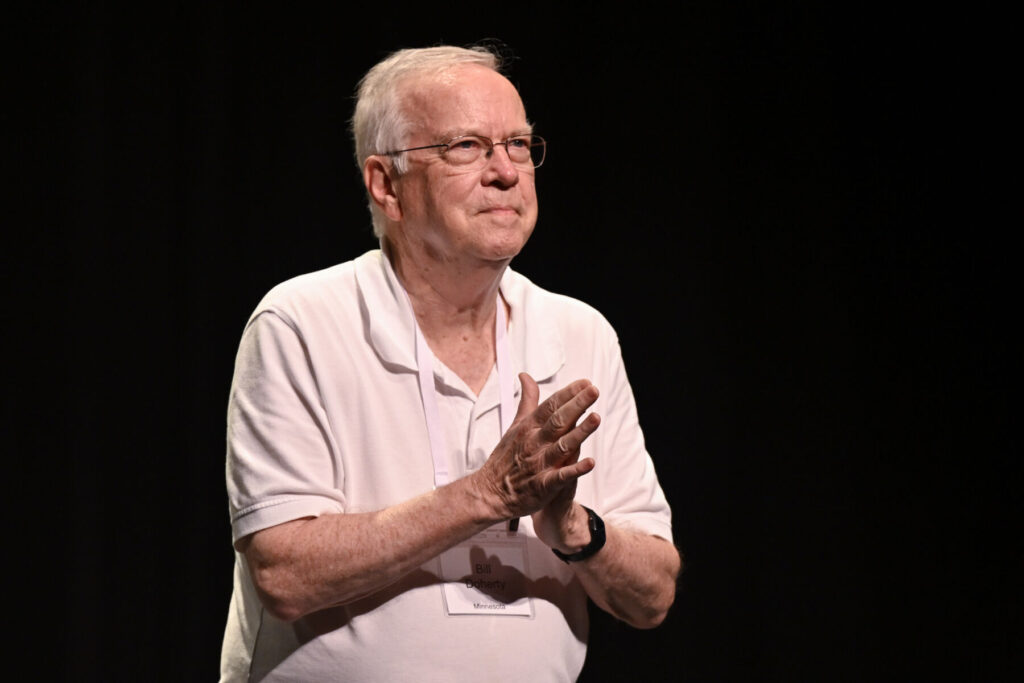
“These are the times that try men’s souls.” Thomas Paine penned these words 250 years ago to inspire Americans at a low point in the Revolutionary War. We are at another low point now—this time fighting each other rather than a colonial ruler. I live in the Minneapolis area, where I am witnessing the tearing of the social fabric. The soul of Braver Angels is also being tried, with some dedicated members wondering if our mission is still relevant. They are bluntly asking, “Why keep talking to those people?” This is my written response as a cofounder of Braver Angels. I’ve also recorded a video where I speak more personally about what’s going on in Minnesota.
As a therapist, my job is to help clients do two things with powerful emotions: understand what they are feeling, and then act mindfully rather than react instinctively. Political stress is stirring up two main emotions—fear and outrage—and they feed on each other. Fear can lead to one kind of reactivity: shutting down and withdrawing. Outrage can lead to another kind: demonizing and lashing out. The alternative is hard but possible: thoughtful responses informed by our emotions but not directed by them. It means showing up with a non-anxious presence when others around us are escalating, cutting people off, and losing hope. It takes a special form of courage to keep engaging with people in our lives whose views appall us. Ernest Hemingway called courage “grace under pressure.” We live in a pressurized time, when courageous citizenship requires real emotional work.
So far, I’ve described how we can function psychologically in a national crisis. But what about social action?
I think of work for social change as happening in three ways: Resist, Replace, and Repair—three Rs. All are necessary, and none alone is sufficient.
Resist refers to organized efforts to publicly name serious social problems and confront leaders and institutions that create and reinforce them. Resist is about vigorous, sustained calls for change now. (“We Shall Overcome.”)
Replace refers to what comes next: concrete reforms and changes such as the Civil Rights Act of 1964. Resistance movements need a Replace agenda in order to be effective.
Repair refers to organized efforts to heal the social fabric that is inevitably torn by the turmoil and polarization of major social change—what Lincoln called binding up our wounds. (South Africa’s Truth and Reconciliation Commission, and closer to home, Braver Angels.)
I see all three Rs as essential for successful long-term social change. We have to name injustices. We have to enact concrete solutions. And we have to treat one another with respect while debating the changes—and after one side wins out against opposition. Unfortunately, the repair work is often neglected.
Consider one example from perhaps the most successful social movement in U.S. history: abolitionism in the 19th century. It resisted the institution of slavery and helped replace it through constitutional amendments. But after the Civil War, the work of repair and healing was tepid and ultimately abandoned by many leaders. We are still paying the price.
This framing helps me respond to those who call for Braver Angels to speak out about injustices and abuses of governmental power. If we support democracy, this argument goes, then to not publicly resist these assaults is at best timidity and at worst complicity. The time for talking to the other side is over. They are unreachable; the only thing left is to fight them. (This challenge is coming mostly from progressive Blues distressed by the Trump Administration, but I could imagine a time when it would come from conservative or populist Reds upset, say, with a Mamdani administration.) In effect, the call is for Braver Angels to join the resistance.
My response is threefold.
First, we should distinguish between Braver Angels as an organization and what individual Braver Angels members decide to do with their own efforts at social change. Some may feel called to step away from Braver Angels and focus on Resist. For them, this may be the right season for that choice.
Second, I don’t believe Braver Angels can effectively do Resist and Repair. If Braver Angels camps on one shore, we lose the cross-partisan trust that makes our work possible. Organizations seen as neutral on policy and politicians are best positioned to do the work of healing divisions and bridging divides. I ask: Is the nation better served by Braver Angels adding one more small voice to a resistance and losing our ability to Repair?
Third, somebody has to staff the Repair brigade. Resist often has no shortage of volunteers. Keeping contact through conversation—and feasible joint activities—is essential to the functioning of our democratic republic.
I believe Braver Angels has an opportunity to make a difference only if we stay in our distinctive lane—one we’ve become pretty good at. What’s more, ours is the long game beyond any political leader or party in power. The forces of polarization that brought us to this crisis moment are not going away soon. Our work, in the Hebrew phrase, is Tikkun Olam—repairing the world. It is a never-ending human endeavor. And it matters, because when the talking stops, the only alternatives are coercion and violence. I’m seeing that danger up close right now in Minneapolis, where local and national leaders have stopped talking, and escalation is overtaking us. I pray that the talking begins and the healing starts soon. We have real work ahead in Braver Angels—and I know we are up to it.
— Bill Doherty, Braver Angels co-founder